
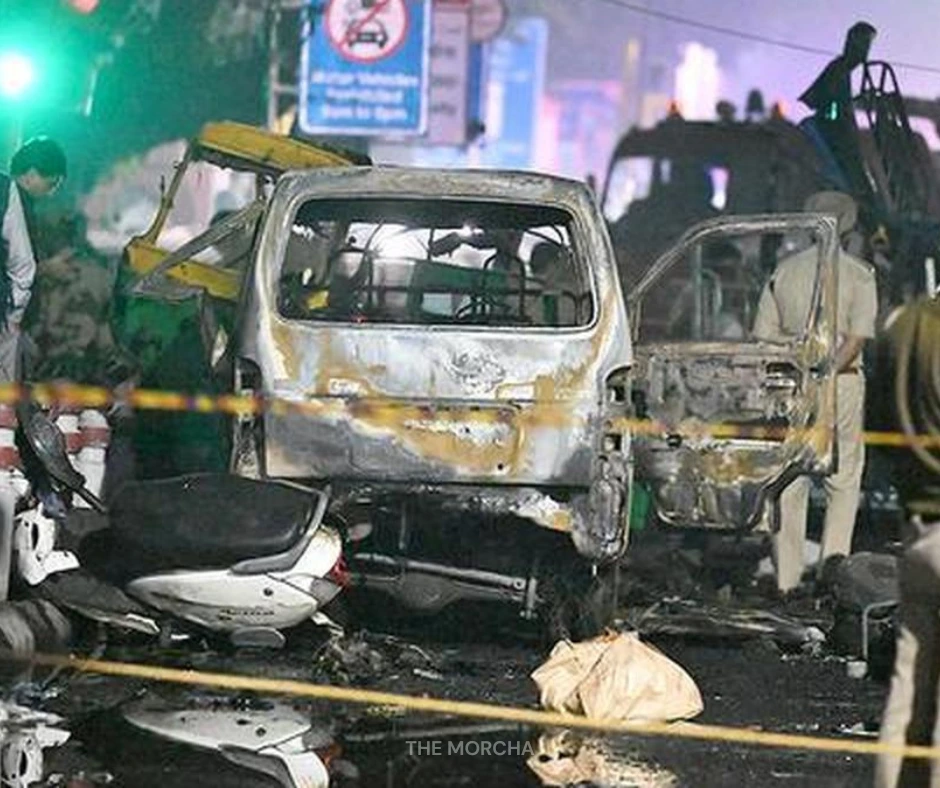
Delhi Blast on 10 November marked a turning point in India’s fight against terrorism. What first appeared to be an isolated explosion was soon confirmed as a planned fidayeen attack, executed with precision and involving highly educated individuals. The revelation that doctors and medical students were part of the plot has shocked the country and exposed a disturbing new trend of radicalisation within academic and medical institutions.
The chain of explosive events—from the 10 November Delhi blast, to the tragic 360 kg explosion at the Naugam police station, to the questioning and arrests of multiple medical professionals across states—illustrates a complex, multi-layered terror ecosystem.


Table of Contents
A Month That Exposed India’s Most Unexpected Terror Web
India is no stranger to terrorism. For decades, radical groups have tried to destabilize peace through fidayeen (suicide) attacks, bombings, cross-border infiltrations, and recruitment of vulnerable youth. But the discoveries of November 2025 mark a deeply unsettling shift.
The key suspects and deceased individuals at the center of these events are not typical insurgents or impoverished foot soldiers. Instead, they include:
- Medical professors
- Postgraduate doctors
- Medical students
- Individuals with advanced scientific knowledge
These are people traditionally associated with healing and saving lives—not plotting destruction.
The involvement of these professionals highlights a dark, emerging trend: radical ideology penetrating spaces previously considered safe, elite, and insulated from such influences.
The incidents that unfolded across Delhi, Faridabad, Nuh (Haryana), Anantnag, Srinagar, and Saharanpur reveal an undercurrent of silent radicalisation among a select network of educated youth—indicating the influence of online propaganda, private ideological circles, and foreign-backed extremist groups.
Delhi Blast: When a Suicide Attack Unfolded in the Capital
On 10 November 2025, Delhi witnessed a shocking explosion that initially raised uncertainty—was it accidental or intentional? Within hours, the National Investigation Agency (NIA) began piecing the puzzle together. Soon, the clarity arrived:
The explosion was a meticulously planned fidayeen (suicide) attack, not an accidental blast.
The Accused Plotters: Dr. Aamir Rashid Nabi & Aamir Rashid Ali
According to the NIA:
- Dr. Aamir Rashid Nabi was the suicide bomber who perished in the blast.
- His associate, Aamir Rashid Ali, allegedly provided the car used in the attack.
- Both hailed from Sambooora, Pampore in Kashmir.
- Both shared a hardline, radical ideology, according to sources familiar with the investigation.
Dr. Nabi was associated with the Al-Falah University Medical Department in Faridabad, where he reportedly worked earlier and maintained connections that may have helped facilitate the attack.
The Car: A Mobile IED Unit
Investigators discovered that:
- The car was transformed into an improvised explosive device (IED).
- The modification was deliberate and scientifically executed.
- This implies that the perpetrators were knowledgeable about chemicals and explosive triggers—a skillset more commonly found among individuals with scientific backgrounds.
The use of a car-IED suggests training, planning, and a deliberate attempt to execute a high-impact fidayeen attack capable of causing mass casualties.
Recovery of Ammunition
From the blast site, authorities recovered:
Three 9mm bullets
These bullets raised serious questions.
- Such ammunition is typically carried only by special security units or authorized personnel.
- Its presence indicates that the bomber may have been carrying a firearm—or was assisted by someone who was.
The NIA has questioned 73 individuals, signaling how wide and deeply connected this network may be.
Naugam Police Station Explosion
Just as the Delhi blast investigation gained momentum, another shocking incident shook Kashmir.
In the Naugam Police Station in Srinagar, 360 kg of explosives—seized earlier from terror modules—detonated late Friday night.
At first glance, it seemed like another terror-related blast. But forensic analysis revealed a different, though equally disturbing, truth.
How a Forensic Examination Went Horribly Wrong
A forensic team had been extracting samples from the seized explosive bags. For illumination, they used halogen lamps, which produce extremely high heat.
The explosive bags contained chemicals:
- Acetophenone
- Hydrogen Peroxide
- Sulphuric Acid
When exposed to heat:
- These chemicals reacted violently.
- Toxic fumes began to rise.
- A chain reaction triggered the fatal explosion.
This was not a terror attack—it was an accidental scientific detonation, exposing lapses in:
- Forensic safety protocols
- Chemical storage standards
- Handling methods for unstable substances
The Naugam incident serves as a sobering reminder that even those trained to prevent and analyze terrorism must adhere to strict scientific discipline.

The Grooming of a Fidayeen: The Testimony of Jaseer (Danish)
Perhaps the most revealing insight into the doctor-terror nexus comes from the arrest of Jaseer alias Danish, detained from Qazigund.
During questioning, Jaseer disclosed:
- He met Dr. Aamir Rashid Nabi in October 2023.
- Dr. Nabi attempted to brainwash him into becoming a fidayeen attacker.
- Jaseer was taken to Al-Falah University, where ideologically driven discussions allegedly took place.
- For months, the doctor persistently tried to shape him into a suicide bomber.
A Moment of Resistance
In April 2025, Jaseer refused the offer.
His reasoning was religious:
“Islam declares suicide to be haram. A fidayeen attack is a form of suicide.”
His refusal reflects something essential:
- Radicalisation is not always successful, even with prolonged exposure.
- Some targets resist recruitment due to strong moral or religious convictions.
Jaseer’s testimony further supports investigators’ suspicions that radical recruitment was occurring within academic and medical circles.
The Haryana Safehouse
Another key figure in the widening investigation was Dr. Omar Nabi, who died in the Delhi blast. Police traced his recent activities to a house in Nuh (Mewat district, Haryana), an area already on the intelligence radar for radical activity.
The Mysterious House Under Scrutiny
Key facts about the Nuh residence:
- The house belonged to Shaheed, currently imprisoned.
- His daughter Afsarana lived there and vanished with her child after the blast, locking the property.
- The police have detained her brother Rizwan for questioning.
- The STF seized multiple CCTV DVRs from the area.
- The house is modest, around 100 square yards, but strategically located.
Authorities are exploring:
- Whether the house was used as a safehouse
- Whether meetings occurred there
- Whether radical materials or explosive components were stored
Interestingly, the NIA questioned three local doctors and a fertilizer/seed vendor—all later released. Their involvement may have been peripheral or based on proximity, but their questioning underscores investigators’ concern about the formation of professional-level radical networks.
The Detention of Dr. Priyanka Sharma
As the investigation widened, the Counter Intelligence Unit in Jammu & Kashmir detained Dr. Priyanka Sharma, a postgraduate medical student from Rohtak, studying in Anantnag.
Why She Was Detained
Priyanka was questioned because of her academic link to:
- Dr. Adil Ahmad, arrested in Saharanpur for alleged extremist ties.
Dr. Adil was her:
- Senior Resident (SR)
- Instructor and mentor during her MD coursework
Priyanka clarified:
- She knew him only through their college academic environment.
- She had no knowledge of his alleged terror associations.
Notably:
- She was detained for only 30 minutes.
- Her phone was taken for digital forensic analysis.
- She was released after initial verification.
Her father later confirmed that the questioning was routine and not accusatory.
This case highlights the web of academic relationships that can cause innocent connections to come under scrutiny during terror investigations.
The Rise of Radicalised Medical Professionals: A Startling Trend
The involvement of doctors raises serious questions:
- Why would highly educated individuals, trained to save lives, participate in terror activities?
- How does radicalisation penetrate elite academic spaces?
- Is this a one-off case or part of a larger pattern?
Why Doctors Appeal to Terror Recruiters
Doctors possess:
- Advanced scientific knowledge (useful for chemicals, explosives, medical concealment)
- High credibility in society
- Access to restricted labs, drugs, or chemicals
- Low suspicion levels at checkpoints or institutions
- Ability to influence young students
Extremist groups worldwide have long recognized that educated recruits provide:
- Improved operational planning
- Higher success rates
- More complex attacks
- Easier access to technology and resources
International Precedents
There have been global examples:
- 2007 Glasgow Airport attack: carried out by two medical professionals
- Radicalized doctors in the Middle East assisting extremist groups
- Medical students in the UK caught with bomb-making literature
- Doctors in conflict regions providing medical assistance to militants
India is now witnessing a similar, though nascent, trend—one that must be addressed urgently.
The Psychology of Radicalisation Among Educated Individuals
Contrary to popular belief, education does not always protect against radicalisation. In fact, several studies show:
- Intellectual arrogance may make individuals feel morally superior.
- Educated radicals can create sophisticated justifications for violence.
- They may be drawn to the “purpose” and “identity” that extremist ideology offers.
- Stress, isolation, and lack of belonging can create emotional vulnerability.
- Online propaganda specifically targets professionals by appealing to their intellect.
The Ideological Vacuum
Many medical students, especially those studying away from home, experience:
- Loneliness
- Cultural shifts
- Academic pressure
- Lack of emotional support
- Exposure to intense debates about religion, identity, and injustice
This makes them potential targets for:
- Radical mentors
- Online extremist channels
- Ideological groups operating in secrecy
- Charismatic figures like the accused doctors in this case
Radicalisation rarely happens in isolation—it usually involves a network, a mentor, or a reinforcing environment.
How the Network Operated
From the various locations and suspects involved, investigators believe:
- There existed a small but committed circle of radicalised medical professionals.
- They used academic and medical institutions as recruitment and meeting grounds.
- Chemicals accessible in labs or medical environments may have been diverted or studied for explosive use.
- Safehouses across Delhi, Haryana, and Kashmir supported movement and concealment.
- Cars, digital devices, and university spaces were leveraged for coordination.
This is not a large terror outfit—but a deeply dangerous micro-network, capable of triggering high-impact events.
Loopholes Exposed in Universities, Chemical Handling, and Intelligence Sharing
University-Level Oversight Gaps
Universities often lack:
- Campus monitoring units
- Radicalisation-awareness programs
- Background checks for visiting staff or tutors
- Reporting channels for suspicious behavior
The fact that alleged radicalisation discussions occurred inside a university hints at systemic gaps.
Chemical Handling Flaws
The Naugam explosion revealed:
- Forensic units must update their protocols.
- Heat-emitting equipment must be strictly avoided near volatile chemicals.
- Chemical storage in police stations must follow scientific guidelines.
Inter-State Intelligence Coordination
The suspects moved between:
- J&K
- Delhi
- Haryana
- UP
This requires real-time data sharing, not delayed communication.
Public Reaction
People across India reacted strongly. The idea of doctors being involved in terrorism:
- Breaks public trust
- Creates fear within student communities
- Raises questions about campus safety
- Sparks debates about ideology vs. religion
- Encourages demand for stronger anti-radicalisation laws
Families of medical students are particularly worried—wondering whether campuses truly remain safe spaces for learning.
What Needs to Be Done: Policy Recommendations
Based on the unfolding events, several policy measures are essential.
Strengthening Campus Vigilance
- Workshops on spotting radicalisation
- Confidential reporting systems
- Counseling units for distressed students
- Faculty training to identify ideological grooming
Chemical Monitoring Laws
Dual-use chemicals (science/medical + explosive potential) must be:
- Logged
- Tracked
- Sold with records
- Monitored for large purchases
Unified Intelligence Grid
A combined intelligence system could:
- Track suspicious movement across states
- Flag individuals with radical links
- Cross-check university records with national alerts
Digital Surveillance on Radical Content
Much radicalisation now happens online. Controlled measures—without violating privacy—must monitor extremist channels.
Closing Analysis
The events of November 2025 are more than isolated incidents—they are warning signs.
They show:
- Extremism can infiltrate elite professions.
- Radicalisation can occur quietly in neighbourhoods, campuses, or labs.
- Even individuals expected to uphold ethics and save lives can fall prey to ideology.
- Terror networks are evolving, recruiting smarter operatives.
India’s security agencies acted swiftly, but the challenge ahead is long and complex.
To safeguard the future, the country must adopt a holistic, multi-layered strategy, focusing not only on arrests but on prevention—inside classrooms, medical institutions, online spaces, and communities.
The Delhi blast, the Naugam accident, the testimonies of attempted fidayeen grooming, the arrests of radicalised medical professionals, and the academic connections under investigation reveal India’s most unexpected terror network yet.


