
Surya Grahan 2026 is one of the most anticipated celestial events of the year. Eclipses have fascinated humans for centuries, blending scientific curiosity with cultural and spiritual significance. This year, the eclipse is an annular solar eclipse, popularly known as the Ring of Fire, which occurs when the Moon comes directly between the Sun and the Earth but is slightly farther from the Earth, leaving a bright ring of sunlight visible around the Moon.
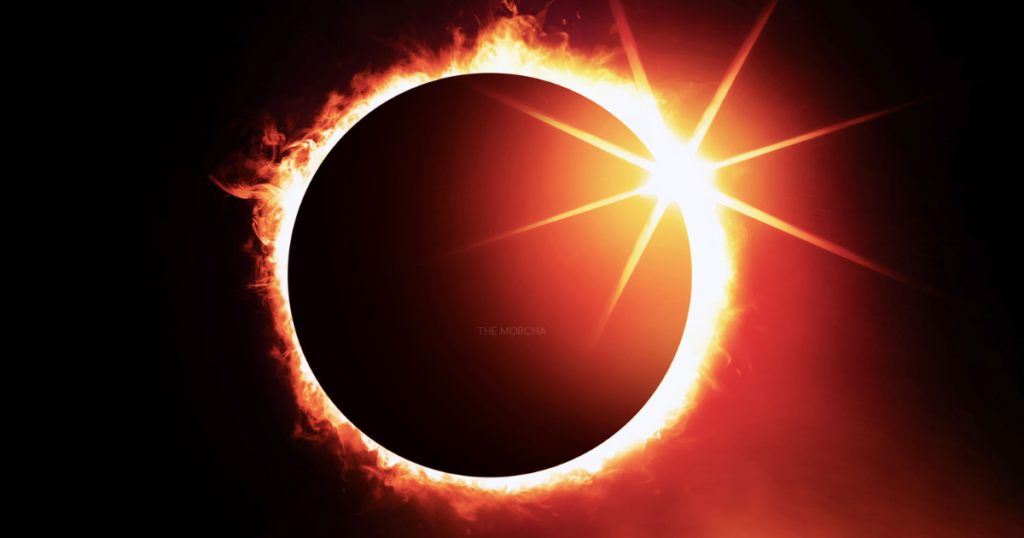
In India, the eclipse timing according to Indian Standard Time (IST) is from 3:26 PM to 7:57 PM, with the maximum eclipse occurring around 5:13–5:42 PM. Although the eclipse itself will not be visible in India, its occurrence is still significant in both astronomy and Hindu tradition.
Table of Contents
What Is a Solar Eclipse?
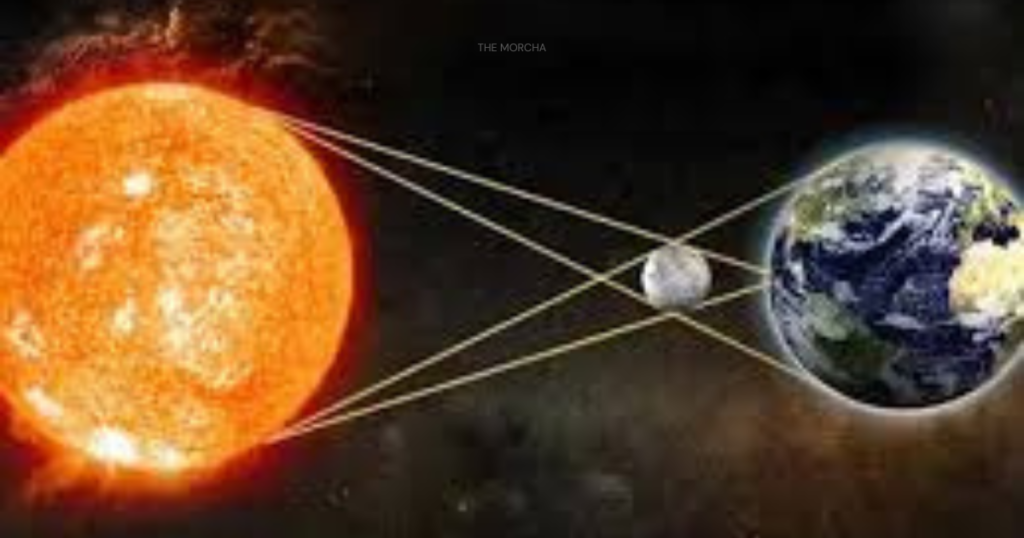
A solar eclipse happens when the Moon passes directly between the Earth and the Sun, partially or completely blocking sunlight from reaching certain parts of the Earth. This rare celestial alignment creates a dramatic visual effect in the sky, attracting both scientists and skywatchers. There are three main types of solar eclipses: total, where the Moon completely covers the Sun; partial, where only a portion of the Sun is obscured; and annular, where the Moon covers the Sun’s center but leaves a bright, glowing ring around the edges.
The 2026 eclipse is an annular one, often called the “Ring of Fire.” Even if the eclipse is invisible from India, its timing is important globally for astronomical observations, scientific calculations, and cultural or religious observances. Solar eclipses help astronomers study the Sun’s corona, test theories of gravity, and improve our understanding of orbital mechanics, making them both a spectacular natural phenomenon and a vital tool for scientific research.
Scientific Explanation of the 2026 Annular Eclipse
The annular solar eclipse is a rare and fascinating celestial event because the Moon’s apparent diameter is slightly smaller than that of the Sun. As a result, it cannot completely cover the Sun, leaving a bright, glowing ring around the Moon’s silhouette, famously known as the “Ring of Fire.” This phenomenon occurs because the Moon follows an elliptical orbit around the Earth, and during this eclipse, it is at or near its apogee, the farthest point from Earth, making it appear smaller in the sky. Although the eclipse will not be visible from India, the precise alignment of the Sun, Moon, and Earth will take place worldwide, demonstrating the incredible predictability of celestial mechanics.
The path of annularity will traverse parts of Southern Africa, South America, and Antarctica, providing astronomers, astrophotographers, and skywatchers a unique chance to observe and study the Sun’s corona, the interplay of light and shadow, and atmospheric effects caused by the eclipse. Events like these also allow scientists to refine calculations of orbital distances and timings, offering critical insights into the gravitational interactions and motions of celestial bodies in our solar system.
Timing of Surya Grahan in India
According to Indian Standard Time (IST), the 2026 solar eclipse begins at 3:26 PM, reaches its maximum intensity around 5:13–5:42 PM, and finally concludes at 7:57 PM. These precise timings are important not only for astronomers but also for people following Hindu traditions and astrology, as many rituals and observances are linked to the exact moments of the eclipse. Although the eclipse will not be visible in India, noting these timings helps individuals plan spiritual practices such as chanting mantras, meditation, or performing pujas after the eclipse.
Additionally, the timing is useful for global tracking of the event, enabling live-streams and scientific observations from regions where it will be visible. Observing these IST timings allows devotees to remain connected with the cosmic alignment and maintain cultural continuity, reflecting how ancient traditions and modern astronomy intersect. By following these timings, individuals can also educate younger generations about the significance of eclipses in both scientific and spiritual contexts, fostering awareness of celestial events.
Visibility of the Eclipse in India
Despite the precise timing of the 2026 solar eclipse in Indian Standard Time (IST), the event will not be visible from any region in India, as the Sun will have already set in the parts of the world where the eclipse occurs. This means that skywatchers and astronomy enthusiasts in India cannot observe the eclipse directly with the naked eye or telescopes. However, thanks to modern technology, observers can still follow the eclipse through live streams, online simulations, or real-time news updates from regions where it is visible.
The path of annularity passes over countries such as Zimbabwe, Zambia, Namibia, Mauritius, and parts of Argentina and Chile, offering a spectacular view of the “Ring of Fire.” These regions will experience the complete effect of the annular eclipse, making it a major astronomical event globally. For India, while physical observation isn’t possible, the timing is still important for astrology, cultural awareness, and scientific documentation. Additionally, virtual viewing allows enthusiasts to appreciate the eclipse from afar and understand its mechanics, emphasizing how global connectivity and technology make even invisible celestial events accessible to everyone.
Understanding Sutak Kaal
Sutak Kaal refers to a specific period of inauspiciousness that is observed in Hindu tradition before and during an eclipse, whether solar or lunar. Traditionally, Sutak begins approximately 12 hours prior to the scheduled eclipse time and continues until the eclipse has completely ended. During this period, devotees are often advised to avoid cooking, eating, performing sacred rituals, or starting any new ventures, as it is considered a time when negative energies may be stronger. Many families use this period for reflection, meditation, and spiritual cleansing, viewing it as a chance to pause and focus on mental and spiritual well-being.
However, for the 2026 solar eclipse, Sutak Kaal is not observed in India, since the eclipse will not be visible in the country, according to regional Panchang calculations. Despite this, astrologers and scholars often note the timing in calendars to maintain awareness of cosmic events and their significance. Even without visible effects, knowing the period of Sutak Kaal helps connect cultural tradition with astronomical phenomena, emphasizing the symbolic importance of eclipses in spiritual life and the disciplined observances that accompany them.
Cultural and Religious Significance
Solar eclipses have held profound cultural and spiritual significance in India for thousands of years. Ancient Hindu texts and scriptures often describe eclipses as moments when cosmic forces align, creating unique energies that can influence both nature and human life. During visible eclipses, many Hindu families traditionally observe fasting, chanting sacred mantras, performing meditation, and offering prayers to the Sun and other deities. Even though the 2026 eclipse will be invisible in India, religious scholars still mark the event in Panchangs and almanacs to maintain awareness and symbolic observances.
These practices emphasize the deep connection between astronomy and cultural tradition, illustrating how celestial phenomena are woven into spiritual life. Observing or noting eclipses encourages reflection on the cycles of time, cosmic order, and the impermanence of worldly matters, reminding devotees to focus on inner purity, mindfulness, and devotion. Even without physical visibility, the event serves as a spiritual marker, helping communities preserve ancient rituals and maintain continuity in cultural practices.
Astrological Implications
In Vedic astrology, solar and lunar eclipses are carefully studied to assess their effects on planetary positions and influence on different zodiac signs. A Surya Grahan (solar eclipse) is often believed to impact areas such as health, wealth, career, relationships, and personal life, depending on the individual’s natal chart. The 2026 solar eclipse, occurring in a specific astrological sign, will have varied interpretations for each zodiac, and astrologers often provide guidance on how to minimize potential negative effects.
During eclipse periods, many astrologers recommend reflection, chanting of mantras, meditation, and spiritual practices to strengthen mental clarity and mitigate any adverse influence. Eclipses are also seen as opportunities to release past karmic burdens and cultivate inner growth, making them important not only for prediction but also for self-improvement and spiritual awareness. Even when invisible in a particular region, such as India in 2026, astrologers emphasize the symbolic and energetic importance of these celestial alignments.
Rahu and Ketu
In Hindu mythology, eclipses are often explained through the legend of Rahu and Ketu, two shadow planets that play a significant role in cosmic events. According to the story, Rahu, a demon, disguised himself to drink the divine nectar of immortality meant for the gods. When the Sun and Moon exposed his deceit, Lord Vishnu decapitated Rahu, but because he had already consumed the nectar, his head became immortal and is called Rahu, while his body became Ketu. Rahu is said to occasionally swallow the Sun or Moon out of anger or revenge, causing solar or lunar eclipses.
This myth symbolically represents the victory of light over darkness and the cyclical struggle between good and evil. Over centuries, this story has profoundly influenced rituals, cultural narratives, and spiritual practices, such as fasting, chanting, and meditation during eclipses, emphasizing moral and cosmic lessons. Even today, Rahu and Ketu are considered significant in astrology, guiding interpretations of eclipses, karmic effects, and personal growth. This myth not only explains celestial phenomena but also connects them to ethical and spiritual symbolism in Hindu tradition.
Rituals During Solar Eclipses
Even though the 2026 solar eclipse will not be visible in India, certain communities and devoted individuals may still observe traditional rituals during the eclipse period. Common practices include chanting Surya mantras, engaging in meditation, cleaning and purifying the home, and reciting sacred texts such as the Vedas or Adityahridayam. Many people also perform purification baths after the eclipse ends, believing that water absorbs the negative energies present during the eclipse.
These rituals are intended to foster spiritual cleansing, enhance mental clarity, and harmonize with the cosmic energies associated with the Sun and Moon. Observing such practices reflects reverence for the Sun, which is considered a source of life and vitality in Hindu tradition. Beyond religious devotion, these rituals also provide a structured period of reflection, mindfulness, and inner calm, allowing practitioners to reconnect with nature, celestial cycles, and the rhythm of time. Even without direct observation of the eclipse, the symbolic and spiritual significance of these rituals continues to influence cultural and religious life in India.
Dos and Don’ts
- During the eclipse, avoid cooking or eating.
- Avoid starting new ventures or major decisions.
- Pregnant women are advised to rest indoors.
- Do not cut nails or hair, as these activities are considered inauspicious.
Traditional beliefs advise avoiding certain activities during eclipses:
Although these are cultural practices rather than scientific rules, they reflect the historical and spiritual perspectives associated with eclipses in India.
Eclipse Safety Measures
For eclipses visible in other parts of the world, eye safety is critical. Without the right protection, staring directly at the sun can result in irreversible harm. Certified solar eclipse glasses (ISO 12312-2) or indirect viewing methods, such as pinhole projectors, are recommended. Even though India will not witness this eclipse, global viewers must follow these precautions to safely enjoy the event.
Comparing Solar and Lunar Eclipses
Lunar eclipses differ from solar eclipses in that the Earth casts its shadow on the Moon as it moves between the Sun and the Moon. Lunar eclipses are usually visible from a much wider geographic area, making them easier to observe without specialized equipment such as eclipse glasses. Solar eclipses, on the other hand, require a precise alignment of the Sun, Moon, and Earth and are visible only along a narrow path, which is why the 2026 Surya Grahan will not be seen from India.
The difference in visibility highlights the complexity and rarity of solar eclipses compared to lunar ones. While lunar eclipses are gradual and can be enjoyed by millions across continents, solar eclipses like the 2026 annular eclipse provide a dramatic visual phenomenon for a limited audience. This contrast also emphasizes the importance of careful astronomical calculations and global coordination for observation and scientific study. Understanding these differences deepens appreciation for both types of eclipses and their cultural, spiritual, and scientific significance.
Scientific Importance
Solar eclipses play a vital role in advancing scientific research and understanding of our solar system. Observing eclipses allows astronomers to study the Sun’s outer atmosphere (corona), solar flares, and their impact on Earth’s magnetosphere and climate. Even annular eclipses, like the 2026 Surya Grahan, provide valuable opportunities to analyze orbital mechanics, the Moon’s trajectory, and precise celestial alignments, which help refine astronomical models. These events also contribute to improving eclipse predictions and timing calculations, which are crucial for both scientific research and public safety.
Additionally, solar eclipses serve as educational opportunities, inspiring students and the general public to engage with astronomy, understand celestial phenomena, and appreciate the scale and precision of our solar system. By combining observation, measurement, and public engagement, eclipses like the 2026 Surya Grahan help bridge scientific knowledge and societal curiosity, making them both spectacular and scientifically significant events.
Historical Perspective
Throughout history, solar eclipses have fascinated humans and were often observed with a mix of awe, fear, and reverence. Many ancient civilizations, including Indian, Greek, Chinese, and Mesopotamian cultures, meticulously recorded eclipses in manuscripts, inscriptions, and astronomical charts, using them to track celestial events and predict natural phenomena. In India, texts such as the Surya Siddhanta documented the positions and timings of eclipses, blending scientific observation with spiritual interpretation.
Eclipses were sometimes considered omens or messages from the heavens, influencing decisions of kings, rulers, and communities. The 2026 Surya Grahan continues this long-standing tradition, combining precise modern astronomical calculations with centuries-old observational knowledge, highlighting the continuity between ancient cultural wisdom and contemporary scientific methods. By studying eclipses today, scientists and historians alike can trace humanity’s enduring fascination with the skies and the Sun-Moon-Earth alignment, connecting modern astronomy with historical and cultural heritage.
Modern-Day Observations
In today’s digital and connected era, solar eclipses can be observed and followed globally through live streams, virtual simulations, and educational content. Even in regions where the eclipse is not physically visible, such as India during the 2026 Surya Grahan, enthusiasts can experience the event virtually, track its progression, and learn about its scientific and astronomical significance.
This technological accessibility bridges the gap between modern science and traditional interest, allowing people to appreciate celestial phenomena, understand the mechanics of the Sun-Moon-Earth alignment, and engage in discussions about astronomy, culture, and mythology from anywhere in the world. Virtual participation also provides opportunities for students, researchers, and amateur astronomers to document the eclipse, analyze its effects, and share knowledge widely, making celestial events like the 2026 eclipse both educational and culturally enriching.
Planning for Future Eclipses
Awareness of eclipse timings, Sutak Kaal, and visibility allows individuals to plan future observances thoughtfully and safely. Those interested in spiritual rituals, fasting, or astrological practices can prepare in advance to align their activities with the eclipse period. Similarly, astronomy enthusiasts and photographers can plan travel to regions where the eclipse will be fully visible, ensuring the best viewing experience.
Understanding the timing, scientific significance, and cultural context of the 2026 Surya Grahan also helps people engage with celestial events responsibly, appreciate their rarity, and use these moments for reflection, learning, and meaningful participation in both traditional and modern practices. Such planning promotes a balanced approach to astronomical, cultural, and spiritual observances, enhancing the overall experience of witnessing or marking eclipses.
The Significance of Surya Grahan 2026
Although the 2026 solar eclipse will not be directly visible in India, its occurrence remains highly significant. The event bridges astronomy, astrology, cultural beliefs, and mythology, highlighting how humans interpret and respond to cosmic phenomena.
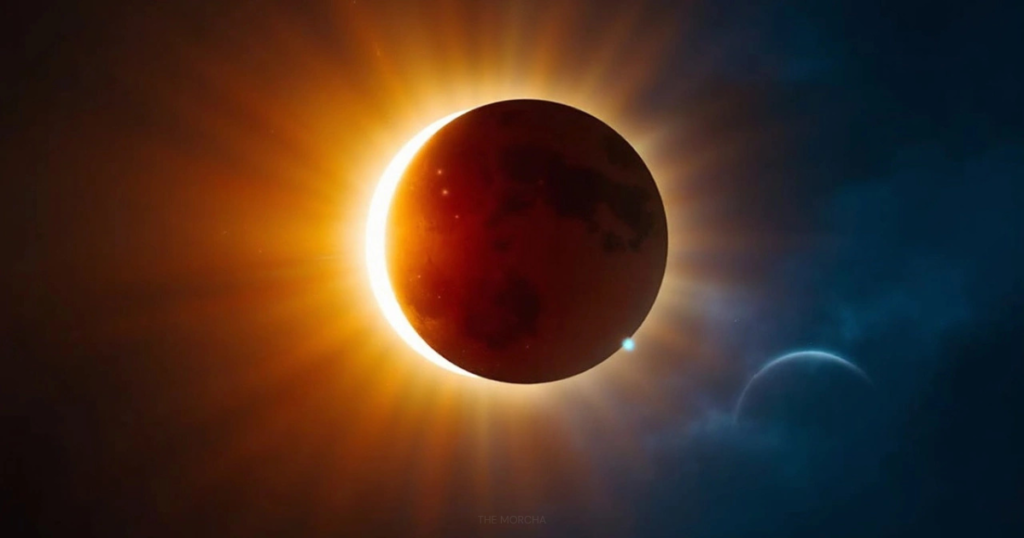
Whether for scientific curiosity or spiritual observance, Surya Grahan 2026 offers an opportunity to reflect on the intricate dance of celestial bodies, the influence of cosmic cycles on life, and the enduring fascination humans have with the Sun, Moon, and sky.