
Mysterious ‘Treasure’ Discovered in Tonk In early January 2026, a quiet and largely unnoticed rural settlement in the Tonk district of Rajasthan suddenly found itself thrust into the national spotlight when reports emerged that a mysterious object had been discovered buried deep beneath the ground. What initially appeared to be an ordinary patch of land, used for everyday village activities, soon became the center of intense curiosity, speculation, and excitement. Rajasthan, a state deeply intertwined with India’s historical memory, has long been associated with legends of buried wealth—stories of kings concealing gold during invasions, merchants hiding riches to protect them from looters, and families safeguarding valuables in times of war and political instability.
These stories, passed down orally through generations, have shaped a collective belief that the land itself holds secrets from the past, waiting to be uncovered. When villagers in Niwai tehsil noticed unusual signs on the ground—details that hinted at deliberate human activity beneath the soil—their curiosity quickly turned into alarm and fascination. What followed was a rapid transformation of a routine local concern into a dramatic and emotionally charged episode involving large crowds, widespread rumors of hidden treasure, urgent police intervention, and the involvement of administrative and archaeological authorities. News of the discovery spread far beyond the village through social media, local networks, and news outlets, igniting public imagination and reviving age-old myths of lost riches.
The incident demonstrated how powerfully the idea of hidden treasure continues to resonate within Indian society, particularly in historically rich regions like Rajasthan, where the boundaries between folklore, history, and reality often blur. More than just a physical discovery, the event became a reflection of collective memory, cultural belief, and the enduring human fascination with the unknown, proving that even in the modern age, ancient legends still possess the power to captivate entire communities.
Table of Contents
Geographical and Historical Context of Tonk District
Tonk district occupies a unique position in Rajasthan’s historical and cultural landscape due to its diverse political and administrative past. Unlike many regions that were ruled predominantly by Rajput dynasties, Tonk experienced a blend of Rajput, Mughal, and later princely-state influences, which shaped its social structure, governance, and cultural traditions. Over the centuries, the district witnessed frequent political changes, military movements, and economic shifts, particularly during times of conflict and instability. These conditions often led rulers, traders, and wealthy families to hide valuables underground to protect them from invasion or looting.
Archaeological discoveries across Rajasthan, including buried coins, metal vessels, weapons, and ceremonial objects, have reinforced local beliefs that the land still holds remnants of its rich past. Although the specific site in Niwai tehsil was not officially recognized as an archaeological area, Tonk’s broader historical background made villagers more inclined to associate the discovery of any unusual underground object with ancient wealth or heritage significance.
Suspicious Signs That Sparked Curiosity and Fear
The sequence of events that eventually led to the dramatic discovery began when local villagers observed a number of unusual and unsettling signs on an open stretch of land commonly used for grazing animals. Fresh rose petals scattered across the soil, an abandoned woman’s slipper lying nearby, and clearly visible tire marks suggested that someone had recently visited the area with deliberate intent. In rural communities, where daily life follows familiar patterns, such irregularities are rarely dismissed as coincidence. Instead, they are often interpreted as signals of something hidden or secretive, possibly linked to rituals, concealed activities, or intentional burial.
These signs sparked intense discussions among villagers, with some expressing fear that a criminal incident might have occurred, while others speculated about occult practices or the deliberate hiding of valuable objects. As these conversations spread rapidly through word of mouth, curiosity quickly escalated into collective concern. The growing sense of unease and fascination ultimately prompted villagers to inform local authorities, believing that only an official investigation could uncover the truth beneath the ground and address the mounting speculation.

Official Excavation and the Moment of Revelation
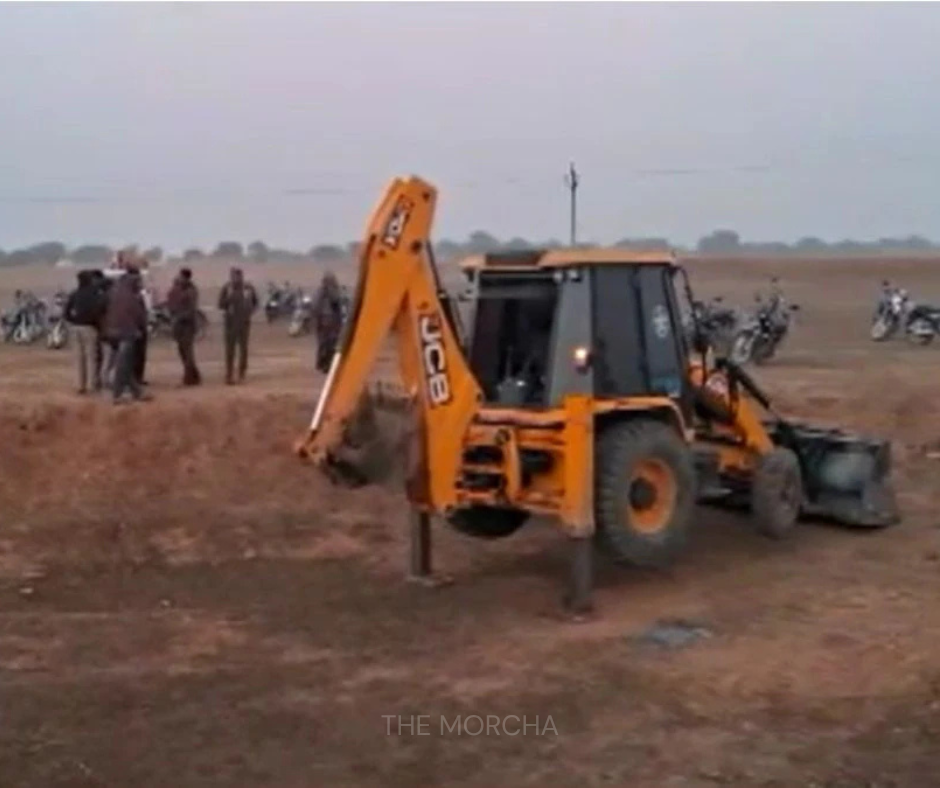
Responding promptly to the concerns raised by the villagers, local police and revenue officials arrived at the site to carry out a carefully controlled excavation, recognizing both the potential significance of the find and the need to maintain law and order amidst growing curiosity. To ensure transparency and prevent the rapid spread of rumors, the authorities deployed a JCB excavator and supervised every stage of the digging process, allowing only a limited number of people to observe from a safe distance. As the machinery slowly penetrated the earth, reaching depths of nearly ten to fifteen feet, more villagers began arriving, drawn by a mix of excitement, anticipation, and the hope of witnessing something extraordinary.
The tension in the air grew with each scoop of soil removed, as conversations among onlookers ranged from speculation about hidden treasure to fears of possible dangers lying beneath. Then, at a critical moment, the excavator struck a solid, heavy object, revealing a large, metallic vessel partially embedded in the soil. The sight of the vessel emerging from the ground instantly transformed the atmosphere from routine administration into a scene charged with intense emotion, disbelief, and eager speculation.
What had begun as a standard procedure to investigate unusual signs in the village had become a historic moment in itself, capturing the imagination of everyone present and setting the stage for the waves of rumors, excitement, and official investigations that would follow in the days to come.
Description and Physical Appearance of the Buried Vessel
The object unearthed from the soil was a remarkably large and heavy metal vessel, resembling what local residents traditionally refer to as a “kalash” or “deg,” forms commonly associated with ceremonial and storage purposes in Rajasthan. Measuring roughly two feet in height and about one and a half feet in diameter, the vessel immediately drew attention due to both its size and the visible signs of age; its surface appeared corroded and weathered, hinting that it had lain buried for decades, if not centuries.
The sheer weight of the container, estimated to exceed one hundred kilograms, made it a challenge to handle, reinforcing the perception among villagers and officials alike that it had been deliberately placed underground rather than being a casual discard or accidental deposit.
Adding to the intrigue, the material of the vessel could not be identified on the spot, leaving open questions about whether it was made of bronze, copper, or some other alloy commonly used in historical storage and ritual objects. The decision not to open the vessel immediately, while legally and scientifically justified, fueled intense speculation among the crowd, as people debated what could lie inside—gold, coins, jewels, or perhaps ritual items—and the suspense surrounding its contents only intensified the sense of mystery, turning a simple excavation into a dramatic and emotionally charged event that would dominate village conversations for days.
Rapid Spread of Rumors and the Psychology of the Crowd
Almost immediately after news of the buried vessel reached surrounding villages, people began converging on the site in large numbers, eager to witness the discovery firsthand. Within minutes, the idea that the container might hold hidden treasure took hold, fueled by centuries-old folklore and oral traditions that speak of kings, traders, and families burying gold, jewels, and valuable artifacts to protect them from invaders or thieves.
In Rajasthan, such stories are woven deeply into the cultural memory, often recounted as cautionary tales or as legends of sudden fortune that could change a person’s life overnight, and seeing a substantial, ancient-looking metal vessel emerge from the ground seemed to many as tangible proof of these long-held beliefs.
As more people gathered, the crowd grew restless and excited, driven not only by hope and curiosity but also by a fear of missing out on a once-in-a-lifetime opportunity. Rational thought often gave way to emotional reactions, as speculation about the vessel’s contents spread rapidly, conversations became animated, and the social energy of anticipation and expectation transformed the quiet village scene into one dominated by heightened excitement, collective imagination, and a shared sense of suspense.
Law-and-Order Challenge and Police Intervention
As the crowd at the excavation site grew to several hundred people, the situation quickly escalated into a serious law-and-order challenge, demanding immediate and careful intervention from authorities. Officials were acutely aware that allowing uncontrolled access to the vessel could lead to looting, physical damage, or even violent confrontations among villagers driven by anticipation and excitement. In response, police forces moved swiftly to establish a secure perimeter, manage the growing crowd, and prevent any individual from approaching the object without authorization.
Under heavy supervision, the vessel was carefully lifted from the excavation site and transported to a government treasury facility, where it was officially sealed and placed under strict custody to ensure both its safety and the preservation of potential evidence. While these actions were necessary to maintain legal and procedural standards, they left many villagers frustrated and disappointed, as numerous onlookers had hoped to witness the vessel being opened or to participate in what they imagined might be the discovery of valuable contents, highlighting the tension between public curiosity and the responsibilities of law enforcement in managing historic or potentially valuable finds.
Cultural Beliefs Behind the Treasure Narrative
The widespread belief that the buried vessel contained hidden treasure was not merely the result of curiosity or speculation, but rather a reflection of deeply ingrained cultural memory and historical experience. Rajasthan’s long history of warfare, invasions, and political instability created conditions in which rulers, merchants, and ordinary families often concealed valuables underground to protect them from invaders or plunder, leaving behind a legacy of hidden wealth that has persisted in collective memory.
Over generations, these practices evolved into folklore, embedding in local consciousness the idea that the land itself could hide immense riches, waiting for the fortunate or observant to uncover them.
These narratives were further amplified by social and economic factors, as poverty, inequality, and daily hardships made the prospect of sudden fortune not just appealing, but almost emotionally necessary, offering hope for a dramatic change in circumstances. In this context, the Tonk discovery became much more than a physical excavation; it emerged as a powerful symbol of potential opportunity and luck, capturing the imagination of villagers and visitors alike, even in the absence of any immediate evidence about the vessel’s actual contents.
Speculation About Rituals and Occult Practices
Adding another layer of intrigue to the Tonk incident were theories suggesting that the buried vessel might not be treasure at all, but rather linked to ritualistic or occult practices, reflecting the region’s rich tapestry of spiritual and symbolic traditions. Observers noted the presence of flowers, scattered personal items, and other unusual signs near the site, which led some locals and officials to speculate that the burial could have held symbolic or spiritual significance rather than material value.
In many rural traditions, objects are intentionally buried as offerings or as part of ceremonies designed to invoke protection, prosperity, or supernatural favor, practices that continue to shape community beliefs even today.
While there was no concrete evidence to confirm these theories, their circulation among villagers and observers highlighted the coexistence of diverse cultural, religious, and mystical frameworks within the community, and added an additional sense of mystery and speculation to an already captivating event. The possibility that the vessel might represent something more symbolic than material contributed to both the suspense and the public fascination, keeping conversations about the discovery alive far beyond the initial excavation.
Legal Framework Governing Buried Objects in India
India’s legal system provides a structured framework for handling discoveries of buried objects that are suspected to be valuable, historically significant, or culturally important. Under laws such as the Indian Treasure Trove Act, the Antiquities and Art Treasures Act, and various heritage protection regulations, any find of this nature must be immediately reported to the appropriate authorities, and unauthorized excavation, removal, or opening of such objects is strictly prohibited. These provisions are designed not only to protect India’s rich cultural and historical heritage but also to prevent illegal trade, damage to artifacts, and loss of important scientific information.
When a buried object is formally assessed, if it is deemed historically or archaeologically significant, it becomes the property of the state, with specialists tasked with its documentation, preservation, and study. In cases where the item is classified as non-heritage personal property, legal mechanisms exist to provide compensation to the finder, ensuring fairness while maintaining order. The Tonk incident serves as a clear example of why these laws are essential: by securing the vessel under official custody, authorities were able to prevent potential chaos, looting, or destruction, while also preserving the opportunity for careful scientific and historical investigation, balancing public interest with legal and cultural responsibility.
Role of Archaeological Experts and Scientific Investigation
The involvement of archaeological experts represents a crucial phase in the unfolding Tonk incident, ensuring that any potential historical or cultural value of the vessel is preserved and properly studied. These specialists are expected to carry out meticulous documentation, employ non-invasive scanning techniques such as ground-penetrating radar or X-ray imaging, and conduct carefully controlled examinations to determine the vessel’s age, material composition, origin, and possible contents.
Such investigations demand patience, technical skill, and precision, as improper handling could easily damage the object or destroy fragile historical evidence that may be embedded in the soil surrounding it.
Even if the vessel ultimately does not contain material treasure, its study can provide valuable insights into ancient craftsmanship, storage methods, or the daily and ritual practices of past societies, shedding light on settlement patterns, trade, and cultural traditions in the region. In this sense, the scientific investigation transforms the discovery from a matter of curiosity and speculation into an opportunity for learning, preservation, and a deeper understanding of Rajasthan’s complex historical landscape.
Possible Interpretations of the Vessel’s Contents
Experts have suggested several possibilities regarding what the vessel might contain, each carrying its own implications for historical and cultural understanding. While the idea of gold, jewels, or other precious valuables cannot be entirely dismissed, such outcomes are considered rare based on similar discoveries in the region. More probable explanations include ritual offerings buried as part of spiritual or ceremonial practices, everyday household storage items such as grains, coins, or utensils, or even an empty container whose original contents may have deteriorated or been removed over time.
Regardless of the presence of material wealth, each scenario holds significance, as even ordinary artifacts can provide insights into the lifestyle, economic conditions, and cultural practices of past communities. Consequently, the true value of the discovery may lie less in the potential of treasure and more in the knowledge it offers to historians, archaeologists, and anthropologists, contributing to a broader understanding of Tonk’s historical, social, and cultural heritage.
Social Impact and Collective Memory
The Tonk incident demonstrates how quickly news and rumors can galvanize communities, influencing collective behavior and shaping social dynamics in profound ways. It highlights the psychological power of hope, anticipation, and belief, particularly in societies like rural Rajasthan, where folklore, history, and cultural narratives play a central role in community identity and daily life. For the villagers who witnessed the events firsthand, the discovery and the ensuing excitement are likely to remain a memorable chapter in local history, retold repeatedly and reinterpreted by each generation, often blending fact and legend over time.
Even if the vessel ultimately contains no material treasure, the story itself contributes to the cultural fabric of the region, reinforcing shared values, beliefs, and the enduring fascination with hidden wealth and mysterious discoveries. The incident serves as a vivid example of how human imagination and collective memory can transform a single event into a symbol of hope, curiosity, and cultural continuity.
Beyond Gold and Riches
Ultimately, the mysterious discovery in Tonk goes far beyond the mere possibility of hidden treasure, serving instead as a reflection of India’s enduring connection to its past and the powerful role of folklore in shaping cultural imagination. The incident highlights the delicate balance between legend and scientific inquiry, where curiosity, belief, and historical investigation intersect, reminding us that not all treasures are material in nature.

As authorities and archaeological experts continue their careful study of the vessel, the event underscores how the pursuit of knowledge, the preservation of heritage, and the understanding of community behavior can provide insights far more valuable than gold or jewels. In this sense, the Tonk discovery has already offered a priceless reward: a glimpse into human belief, collective curiosity, and the ways in which societies interpret the unknown, blending history, myth, and imagination into a story that will be remembered and retold for generations.